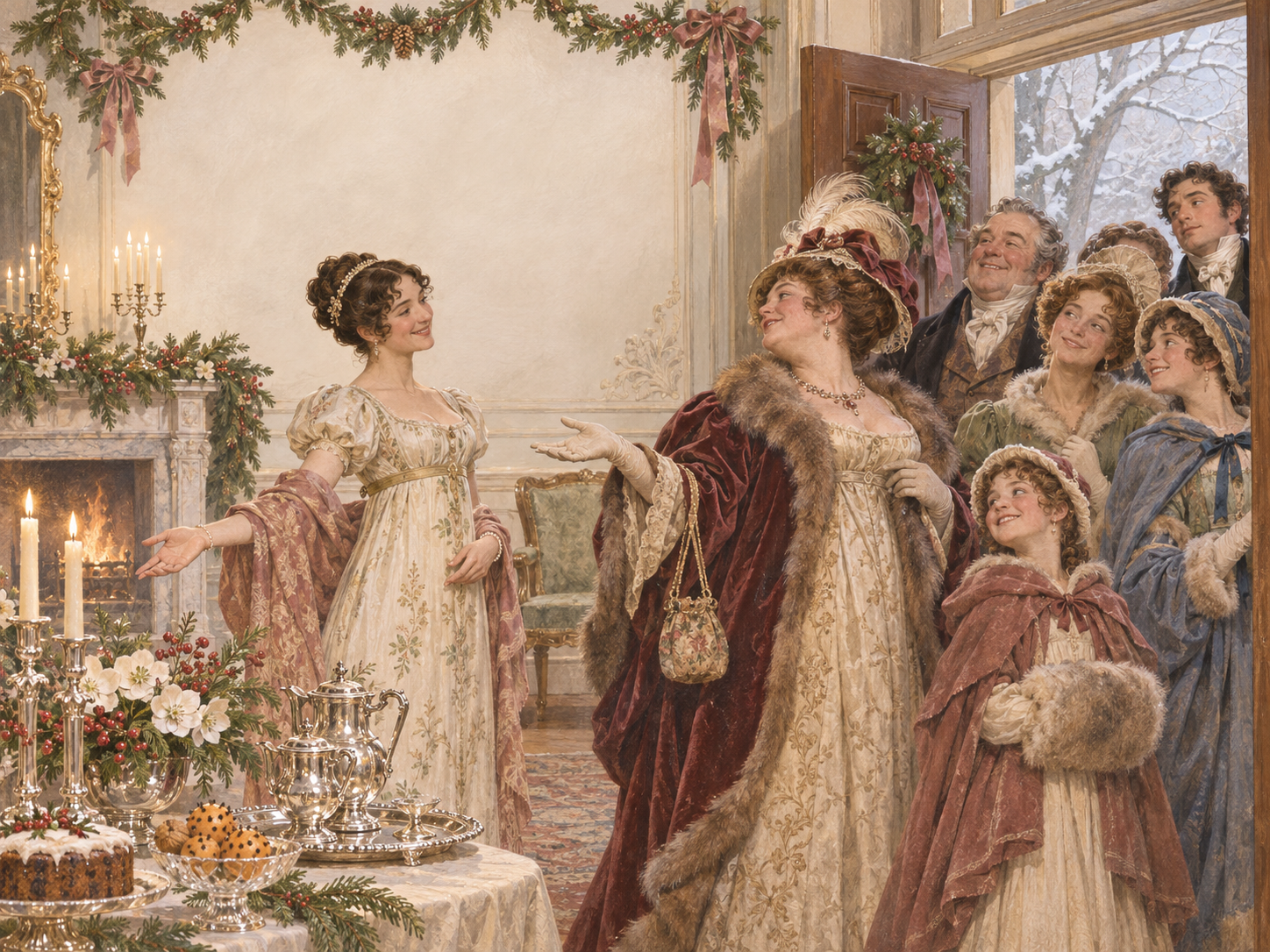
On the delicate art of accepting hospitality without becoming its chief inconvenience.
By Lady Catherine Belletrist
Dearest Reader,
As Thanksgiving approaches and Christmas invitations begin to arrive, one subject demands our immediate attention: holiday guest etiquette.
One might reasonably suppose that accepting hospitality requires little more than arriving at the appointed hour, conducting oneself agreeably, and departing without having caused a domestic incident.
Alas, dear reader, reasonable suppositions have never been a reliable defense against human folly.
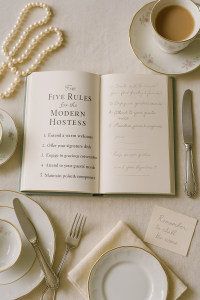
Whether attending Thanksgiving dinner, a Christmas gathering, or a festive soirée, the principles of holiday guest etiquette remain remarkably simple. Respond to invitations, arrive when expected, respect your host’s arrangements, conduct yourself agreeably, and express sincere gratitude.
Yet these modest expectations appear to confound an astonishing number of otherwise functioning adults.
It has come to my attention that certain individuals now regard an invitation as something akin to a declaration of unconditional surrender by the host.
They arrive when they please, bring whom they please, criticize what they please, and depart only when the remaining inhabitants begin contemplating the advantages of a change of address.
Such conduct, I assure you, is not the mark of an independent spirit.
It is the mark of a boor.
Holiday Invitation Etiquette: An Invitation Is Not a Negotiation
Consider, if you will, the unfortunate hostess who extends an invitation to a respectable couple, only to discover upon opening her door that they have brought three additional relations, two children, and an acquaintance whose connection to the family remains entirely mysterious.
One wonders whether they have mistaken a private dinner for the opening of a public house.
An invitation, dearest reader, extends precisely as far as the hostess intends. It is not a hereditary entitlement, nor may its privileges be distributed among one’s acquaintances like surplus Christmas pudding.
Should you wish to bring an additional guest, inquire beforehand. And should the answer be unfavorable, receive it with good grace.
Your hostess is under no obligation to explain the limitations of her dining room, her pantry, or her patience.
Naturally, a gracious hostess should never take pleasure in humiliating an unexpected visitor. Hospitality carries obligations of its own. But consideration must work in both directions, and guests ought not deliberately create difficulties for those who have welcomed them.
One cannot demand generosity whilst displaying none.
RSVP Etiquette: The Lost Art of Answering an Invitation

In Ellye Howell Glover’s Dame Curtsey’s Book of Etiquette, published in 1909, dinner invitations are treated as matters deserving prompt and definite replies.
The principle remains perfectly sound.
A hostess cannot reasonably prepare for twelve guests when five have neglected to reveal whether they intend to appear.
If an invitation requests a reply, provide one by the stated date. If no deadline is given, answer promptly.
Yet modern society has produced an extraordinary class of individuals who receive invitations and respond with the remarkably unhelpful declaration:
“We’ll see.”
Will you indeed?
How reassuring.
One can only imagine the delight of a hostess attempting to calculate portions of roast turkey according to the uncertain intentions of twelve relations.
Accept or decline, my dear. Neither requires an act of Parliament.
A perfectly adequate response might be:
“Thank you for your kind invitation. We would be delighted to join you for Thanksgiving dinner.”
Or, should circumstances prevent your attendance:
“Thank you for thinking of us. Unfortunately, we shall be unable to attend, but we wish you a most enjoyable celebration.”
Having accepted, do not casually abandon the engagement because some more fashionable opportunity presents itself.
Illness and genuine emergencies are another matter. Should circumstances change, communicate the difficulty as soon as possible.
A polite refusal is infinitely preferable to an unreliable acceptance.
Thanksgiving and Christmas Dinner Etiquette: Arrive at the Proper Hour
There exists a curious breed of guest who considers arriving forty-five minutes early an act of generosity.
Such individuals will often announce, with considerable satisfaction, that they have come to help.
The hostess, meanwhile, may be attempting to dress, prepare the vegetables, and locate the serving platter that has mysteriously vanished since the previous Christmas.
Early arrival is not necessarily helpful.
When attending a holiday dinner, observe the arrival time or window provided by your host. If your invitation distinguishes between the time guests are welcomed and the hour dinner will be served, take note of both.
If circumstances make you late, notify your host promptly.
Do not arrive an hour after the appointed meal and expect the entire company to await your entrance as though you were a visiting sovereign.
Punctuality, dearest reader, is not merely a matter of clocks.
It is a matter of respecting another person’s time.
And roast poultry, I assure you, is not particularly sympathetic to one’s difficulties with time management.
What Should a Guest Bring to a Holiday Dinner?
Now, concerning contributions to the holiday table, I am entirely in favor of generosity.
A thoughtful guest may offer to bring a dish, a beverage, or another useful addition to the festivities.
The important word, however, is offer.
Should your hostess request a particular dish, provide it cheerfully. Should she decline your assistance, do not interpret her refusal as a challenge requiring conquest.
There is little kindness in appearing unexpectedly with a casserole demanding forty minutes in an oven already occupied by the principal dish.
If you wish to present a small hostess gift, select something appropriate to the recipient’s tastes. Fine chocolates, preserves, or another modest token may be perfectly charming.
A gift need not be expensive to be thoughtful.
Indeed, as I have previously observed in The Art of Gift-Giving: How to Impress Me with Etiquette, consideration gives a present its true value.
And should you have a food allergy or dietary restriction, communicate the matter discreetly before the gathering. Discussing suitable arrangements in advance is infinitely preferable to discovering at the dinner table that you cannot safely partake of the meal.
Hospitality should be accompanied by understanding on both sides.
A holiday gathering, after all, is not a competition in which the guest must demonstrate his superiority in the culinary arts.
Holiday Table Manners: On Conversation, Discretion, and Family Disputes

Ah, the dinner table!
That sacred ground upon which families gather to give thanks for their blessings and, with astonishing frequency, remind one another of grievances dating back to the previous century.
I have observed that certain guests consider a family meal an excellent opportunity to interrogate unmarried relations, criticize the appearance of others, deliver unsolicited financial advice, and reopen political disputes that ought properly to have been buried years ago.
Dearest reader, a holiday dinner is not a parliamentary debate, a criminal tribunal, or an occasion for conducting an inventory of another person’s shortcomings.
Conversation may certainly be lively. Indeed, I should find a table without spirited discussion terribly dull.
But wit need not be cruel, disagreement need not become hostility, and curiosity does not entitle one to demand answers to every impertinent question that enters the mind.
One may disagree without insulting.
One may decline a question without delivering a manifesto.
One may even permit another person to hold a mistaken opinion without undertaking an immediate campaign for his correction.
An extraordinary concept, certainly.
Nor should the guest complain that the vegetables are overcooked, the gravy insufficiently seasoned, or the hostess’s tablecloth less fashionable than the one recently purchased by Mrs. Whoever-She-May-Be.
Your host has invited you to enjoy a meal, not conduct a culinary inspection.
As for those who conduct telephone conversations upon the speaker whilst seated among their companions, I can only conclude that the invention of modern communication has advanced considerably further than the cultivation of modern judgment.
Your entire acquaintance does not require the privilege of hearing Aunt Mildred discuss her ailments.
Put the contraption away.
The people who have gathered around you deserve something resembling your attention.
When Should You Leave a Holiday Party?

There remains one final accomplishment, sadly neglected by certain holiday visitors.
Knowing when to depart.
It is a curious thing that guests who arrive late so frequently exhibit an astonishing reluctance to leave.
When your hostess begins extinguishing candles, gathering abandoned cups, and remarking upon the early hour at which she must rise, these are not conversational openings.
They are signals.
Should an invitation specify an ending time, respect it. Otherwise, pay attention to the natural conclusion of the gathering and the circumstances of your host.
Do not insist upon another hour of conversation while the household quietly collapses from exhaustion.
Nor should one assume that being family confers permanent rights of occupation.
There is a particular grace in departing before one’s welcome has been entirely consumed.
Take your leave graciously, thank your host and hostess, and allow the household to recover from the pleasures of entertaining.
Thank-You Note Etiquette: Gratitude Does Not Expire at the Door
The final duty of a gracious guest is perhaps the simplest.
Express appreciation.
A thoughtful message the following day, acknowledging the invitation, the meal, or the pleasure of the company, is a small courtesy with considerable value.
A handwritten note remains particularly charming for a formal occasion, although a sincere modern message is perfectly acceptable for an informal gathering.
One might write:
“Dearest Margaret, thank you for such a delightful evening. Your hospitality was most generous, and we thoroughly enjoyed the pleasure of your company.”
The precise medium matters less than the sincerity of the sentiment.
In an age when people are frequently quick to criticize what they receive and slow to acknowledge the effort behind it, gratitude is an accomplishment worth cultivating.
A Few Questions from the Correspondence Desk
May I bring an additional guest to Thanksgiving or Christmas dinner?
Only after receiving your host’s permission. Never assume that an invitation automatically extends to additional relatives, friends, or companions.
Is it rude to arrive early for a holiday gathering?
It may be. Unless your host has requested assistance or approved an earlier arrival, appearing ahead of time can interfere with preparations.
Must I bring a gift when invited to someone’s home?
Not necessarily. A small, thoughtful gift is a gracious gesture, but it is not an admission fee. Your conduct as a guest matters considerably more.
Should I send a thank-you note after a holiday dinner?
A sincere message of appreciation is always welcome. For a formal gathering, a handwritten note is especially thoughtful. For an informal family occasion, a personal message may be entirely sufficient.
Lady Belletrist’s Final Observation
For all the ceremony associated with good manners, the principle at their foundation is wonderfully simple.
Consideration.
The finest guest is not necessarily the wealthiest, most fashionable, or most accomplished person at the table.
It is the individual whose presence adds pleasure rather than difficulty, whose conversation enriches rather than exhausts, and whose departure leaves behind an agreeable recollection.
Such a guest possesses something far more valuable than fashionable connections.
The sincere affection of those who receive him.
And that, dearest reader, is how one secures a second invitation.
For I can assure you that while hospitality may be generously offered, it should never be mistaken for an inexhaustible resource.
Yours in grace, good judgment, and the preservation of civilized society,

Lady Belletrist
Where Grace Survives and Folly Seldom Escapes Notice.




 Let us be plain: this is not hospitality. This is hostage negotiation.





 Choosing the Right Wine




 The Importance of Presentation





 Cotton: Practicality with a Touch of Femininity


 The Purpose of Introductions


 Having comprehended the essence of etiquette, let us now explore why it bears such significance. Etiquette assumes importance for several reasons. Primarily, it aids in averting misunderstandings and conflicts. A familiarity with etiquette precludes inadvertent transgressions that might offend others. For example, in Japan, bowing serves as a customary means of greeting, demonstrating respect, and conveying gratitude. The depth and duration of one’s bow hinge upon the relationship and context. A profound and extended bow signifies greater respect or sincerity. A failure to bow adequately, or indeed, to omit it entirely, may cast one as discourteous or disrespectful.
 My Dearest Readers,